24-Hour Home Care in Dallas: Costs, Live-In vs. Shift Care
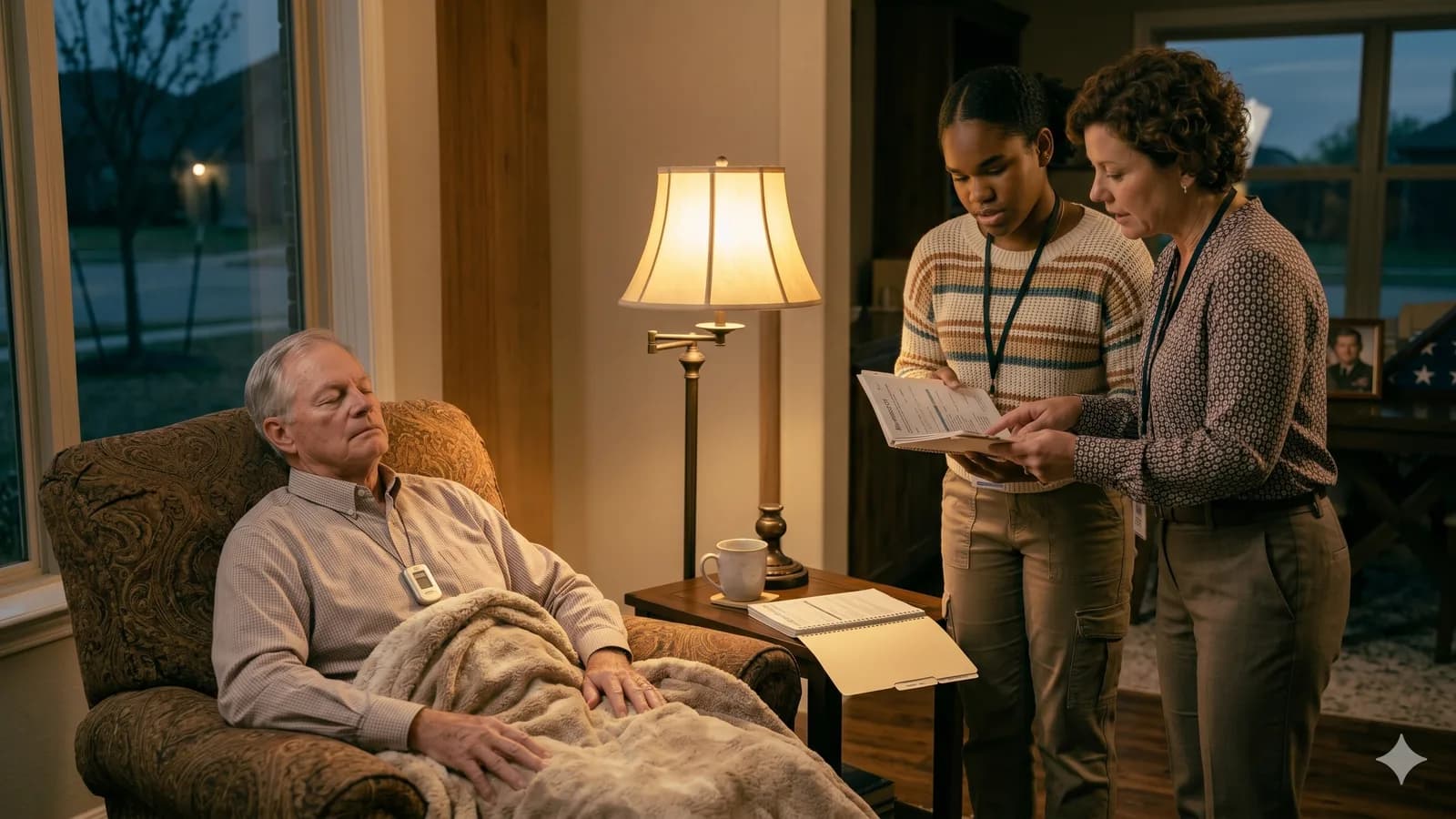
24-Hour Home Care in Dallas: Costs, Live-In vs. Shift Care, and What Families Need to Know
Families searching for 24-hour home care in Dallas usually do it after something changes fast: a fall, a dementia wandering incident, a hospital discharge, or a caregiver who hasn't slept through the night in months.
Around-the-clock care can keep a parent or spouse safely at home in Dallas, Plano, Irving, or Garland when daytime visits are no longer enough. It can also become expensive quickly, so it's important to understand what "24-hour home care" actually means before hiring.
Quick answer: 24-hour home care in Dallas can mean live-in care, awake overnight care, or true 24/7 shift coverage. True 24/7 shift coverage often lands around $20,000–$29,000/month at roughly $28–$40/hour; live-in or targeted overnight models may cost less. Medicare does not cover 24-hour custodial care at home. Families usually pay privately, use long-term care insurance, or explore STAR+PLUS/Medicaid if eligible.
Need a starting list? Compare Texas HHSC-licensed agencies in the Dallas Home Healthcare Directory, then ask each agency which 24-hour model it actually staffs.
What "24-hour home care" means
The phrase gets used loosely. In practice, Dallas families usually mean one of these models:
- Awake overnight care: a caregiver stays awake at night to assist with toileting, wandering, repositioning, fall prevention, or confusion.
- Live-in care: a caregiver stays in the home for an extended shift and is allowed to sleep during designated rest periods. This only works when the client usually sleeps through the night.
- 24/7 shift care: multiple caregivers rotate through the home so someone is awake and responsible for care at all times.
- Daytime care plus family coverage: professional caregivers cover the riskiest blocks of time while family handles evenings, nights, or weekends.
The most important question is: Does someone need to be awake and available at night? If yes, don't assume live-in care is enough.
Live-in care vs. 24/7 shift care
Live-in care sounds simple: one caregiver stays in the home. But live-in care has real limits. A live-in caregiver must be able to sleep, eat, and take breaks. This model can work when the client needs help with morning and evening routines but generally sleeps safely overnight.
Live-in care is usually a poor fit when the client:
- Gets up repeatedly at night
- Wanders or tries to leave the home
- Needs toileting help multiple times overnight
- Needs frequent repositioning
- Has unpredictable sundowning or agitation
- Requires two-person transfers
- Needs clinical monitoring from a nurse
True 24/7 shift care uses multiple caregivers on 8-hour or 12-hour rotations. It costs more, but it is the safer model when the risk is constant.
When Dallas families usually need around-the-clock care
Dementia with wandering or nighttime confusion
Dementia is one of the most common reasons Dallas families move from part-time support to 24-hour home care. A parent may be calm during the day but try to leave the home at night, turn on appliances, mistake a spouse for a stranger, or get up repeatedly and fall.
If wandering, stove use, nighttime agitation, or medication errors are happening, ordinary companion care is likely not enough.
Fall risk and mobility decline
A person who needs help transferring from bed to chair or walking safely may need overnight support if they cannot reliably wait for help. Nighttime falls are especially common because lighting is poor, people are half-awake, and urgent toileting leads to rushing.
Hospital discharge or post-surgical recovery
Some families use 24-hour care temporarily for days or weeks after a hospitalization, fall, stroke, surgery, or rehab stay at a facility in Dallas, Frisco, or McKinney. Then they step down to daytime care as strength and routines improve.
Family caregiver burnout
A spouse providing care day and night can become sleep-deprived, depressed, or injured. Around-the-clock help from a Dallas home care agency protects both the care recipient and the family caregiver.
End-of-life care at home
Hospice provides nursing oversight, medications, equipment, and support — but hospice usually does not place a caregiver in the home 24 hours a day. Families who want a loved one to remain home through end of life often combine hospice with private-pay personal care or private-duty nursing.
What services are included
Most 24-hour home care is personal care, not skilled nursing. Depending on the agency and care plan, caregivers may assist with:
- Bathing, dressing, grooming, and toileting
- Transfers and mobility assistance
- Incontinence care
- Meal preparation and feeding support
- Medication reminders
- Dementia supervision and redirection
- Fall prevention
- Light housekeeping related to care
- Laundry and linen changes
- Overnight monitoring
- Transportation to appointments
- Communication with family members
If the client needs wound care, injections, IV therapy, ventilator or trach-related care, therapy, or clinical assessment, a skilled home health agency, private-duty nurse, or hospice team may also be needed.
What 24-hour home care costs in Dallas
Costs vary by agency, staffing model, and care intensity. Industry benchmarks as of 2025–2026 place non-medical caregiver rates in Texas between roughly $21 and $35 per hour for licensed agency services, with marketplace starting rates typically lower than fully-managed agency care.
Licensed agency quotes for intensive 24-hour care tend to be higher than marketplace starting rates because the agency must cover scheduling, backup staffing, supervision, insurance, payroll taxes, caregiver training, and state compliance.
A simple monthly calculation shows why families need to plan carefully:
| Hourly rate | Approximate monthly cost |
|---|---|
| $28/hour | ~$20,440/month |
| $30/hour | ~$21,900/month |
| $35/hour | ~$25,550/month |
| $40/hour | ~$29,200/month |
These are not quotes. Dallas agencies may price awake overnight care, live-in arrangements, dementia care, two-person transfers, weekend and holiday coverage, and short-notice starts differently.
Many families reduce costs by targeting the highest-risk hours first:
- 8 p.m. to 8 a.m. awake overnight care for wandering or fall risk
- 7 a.m. to 11 a.m. help with bathing, dressing, breakfast, and medications
- Late-afternoon dementia care during sundowning hours
- Temporary 24-hour coverage after a hospital discharge, then tapering down
A good agency should help you build the safest realistic plan, not simply sell the maximum number of hours.
Does Medicare pay for 24-hour home care?
No — not as ongoing custodial care.
Medicare may cover qualifying intermittent skilled home health services when the person is homebound, under a provider's care, and needs skilled nursing or therapy. But Medicare explicitly does not pay for 24-hour-a-day care at home, meal delivery, homemaker services, or custodial personal care when that is the only care needed.
That means a Dallas patient may receive Medicare-covered skilled nursing or physical therapy visits after a hospitalization while the family separately pays for overnight or 24-hour personal care out of pocket.
Can STAR+PLUS help pay for home care?
Sometimes, but expectations matter.
For eligible adults, Texas STAR+PLUS HCBS can include personal assistance services, respite, nursing, adaptive aids, adult day services, and home-delivered meals. The number of authorized hours depends on eligibility, functional assessment, managed care plan rules, and the approved service plan. Not every person who wants 24-hour agency staffing will receive it.
Start with your managed-care plan, Texas HHS resources, and the Dallas Area Agency on Aging. Then ask agencies whether they accept the relevant Medicaid arrangement.
Is 24-hour home care better than assisted living or memory care?
Not always — it depends on the situation.
Around-the-clock home care in Dallas can make sense when:
- The person strongly wants to remain in their home in Arlington, Richardson, or another familiar community
- A spouse still lives in the home
- The home is safe or can be modified
- One-on-one attention is a priority
- Dementia symptoms are better managed in familiar surroundings
- The need is temporary after a hospital stay
- Long-term care insurance or family resources can support the cost
A facility may be more realistic when:
- The home layout is unsafe for caregiving
- The person requires frequent two-person transfers
- The cost exceeds the family's budget
- Medical needs require more structured oversight
- Behavioral symptoms cannot be safely managed at home
- Family caregivers cannot continue even with help
The right answer is not "home at all costs." It is matching the setting to safety, budget, and the person's actual needs.
How to choose a Dallas 24-hour care agency
Ask these questions before hiring:
1. Do you provide true 24/7 shift care, live-in care, or both?
Make the agency explain the difference and confirm which they actually staff.
2. Are overnight caregivers awake or allowed to sleep?
This is a direct safety and cost question.
3. How many caregivers will rotate through the home?
Continuity matters, especially for dementia care.
4. What happens if someone calls out at 10 p.m.?
A 24-hour care plan is only as strong as the backup system.
5. What HCSSA service categories do you hold?
Personal Assistance Services (PAS) may be enough for personal care. Skilled care requires a home health license category from Texas HHSC.
6. How do you handle Dallas-area travel and shift changes?
Traffic, parking, building access, and distance across a metro the size of DFW can affect reliability.
7. Can care be tapered down?
Temporary 24-hour coverage after discharge should not automatically become a permanent maximum-hours plan.
8. What is the full written cost?
Ask specifically about weekends, holidays, overtime, overnight rates, live-in rules, mileage, cancellation policies, deposits, and minimum shift requirements.
The bottom line
Twenty-four-hour home care can keep a loved one safely at home in Dallas through dementia, frailty, disability, surgery recovery, or end-of-life care. It can also cost as much as — or more than — residential care.
Start by deciding whether the person needs a caregiver present, awake, or clinically skilled. Then compare Dallas agencies by licensing, staffing model, backup coverage, caregiver training, and total monthly cost.
Browse Dallas-area home care agencies, then ask direct questions before signing a care agreement.
Related Dallas guides
- Personal Care Services in Dallas
- Private Duty Nursing in Dallas
- How to Pay for In-Home Nursing Care in Texas
- How to Verify a Texas Home Care Agency License
Frequently asked questions
How much does 24-hour home care cost in Dallas?
Costs depend on the agency, staffing model, and care complexity. A 24-hour schedule at $30/hour runs roughly $21,900/month before additional fees. Awake overnight rates, dementia care, weekends, two-person transfers, and skilled nursing components can all affect the final price.
Does Medicare cover 24-hour care at home?
No. Medicare may cover qualifying intermittent skilled home health services, but it does not pay for ongoing 24-hour custodial care at home.
What is the difference between live-in care and 24/7 shift care?
Live-in care allows the caregiver to sleep during designated rest periods. True 24/7 shift care uses multiple rotating caregivers so someone is awake and responsible for care at all times.
When is awake overnight care necessary?
Awake overnight care is typically necessary when the client wanders, gets up repeatedly, needs nighttime toileting help, is a significant fall risk, or cannot safely wait for help until morning.
Can STAR+PLUS pay for 24-hour home care in Texas?
STAR+PLUS may cover personal assistance and other home-based services for eligible members, but authorized hours depend on functional assessment and plan rules. Full 24-hour agency staffing is not guaranteed.
Do Dallas home care agencies serve surrounding suburbs?
Most licensed Dallas agencies serve the broader DFW metro, including Plano, Irving, Garland, Arlington, Frisco, McKinney, and Richardson. Confirm service area and any travel fees when you call.