Private Duty Nursing in Dallas: Costs, Coverage & When to Use It
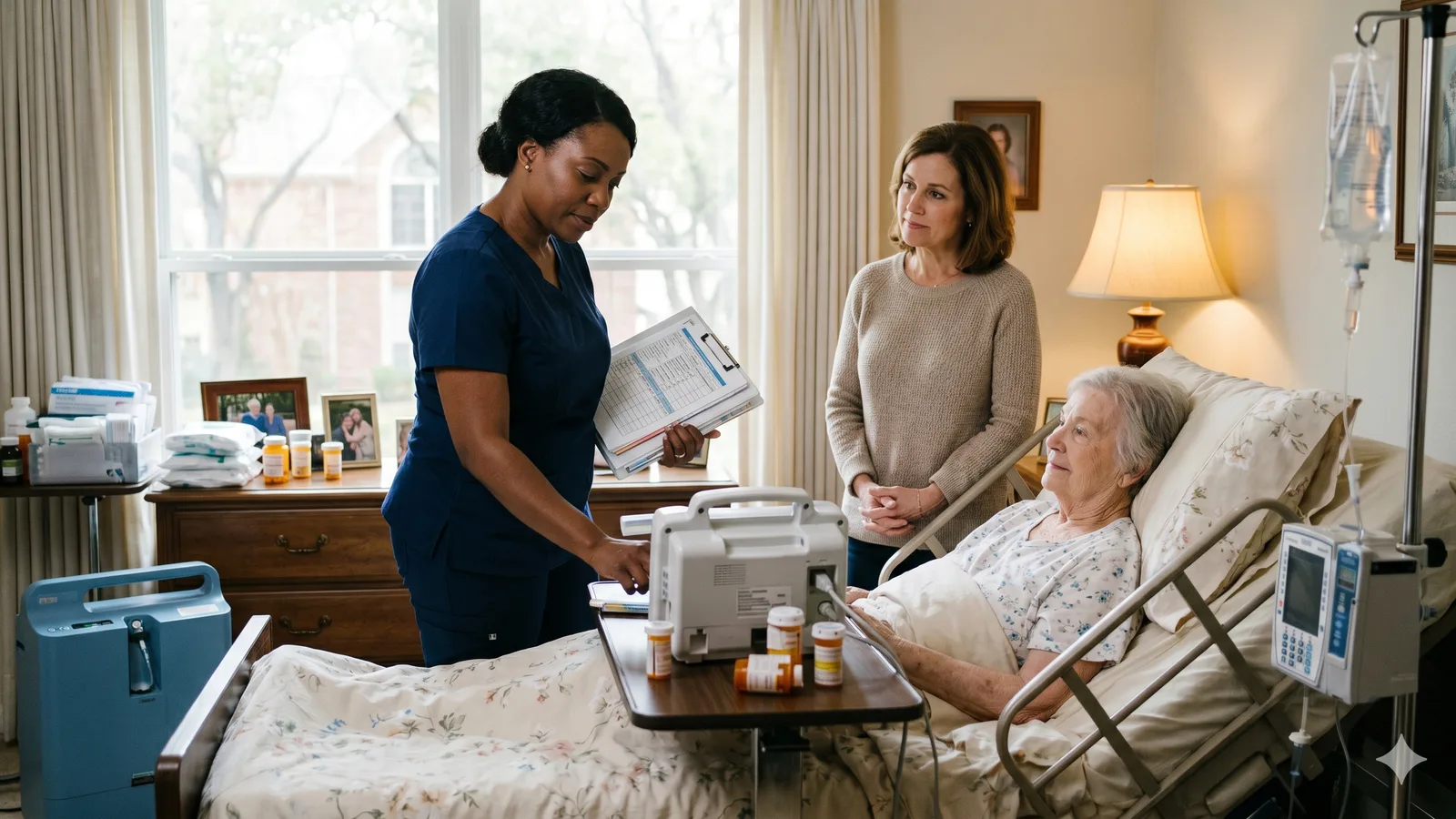
Private Duty Nursing in Dallas: Costs, Coverage, and When Families Need It
Families search for private duty nursing when ordinary home care is not enough. Maybe a parent needs wound care after surgery, a child is coming home with complex medical equipment, a spouse needs medication management after repeated hospitalizations, or an older adult needs longer nursing shifts than a standard home health visit can provide.
Private duty nursing in Dallas can be extremely helpful — but the term is often confused with concierge nursing, home health, personal care, and private caregivers.
Quick answer: Private duty nursing in Dallas usually means one-on-one skilled nursing care delivered by an RN or LVN in the home. It can involve extended shifts, wound care, medication administration, tube feeding, trach/vent support, or pediatric care. It is different from non-medical personal care and different from a short Medicare home health visit. Payment depends on payer, medical necessity, authorization, and the agency's Texas HCSSA license category.
Need a starting list? Compare licensed agencies in the Dallas Home Healthcare Directory, then ask whether they provide private duty nursing directly or only intermittent home health visits.
What private duty nursing includes
Private duty nursing is skilled nursing delivered in the home by a licensed nurse — usually an RN or LVN. The care is more clinical than personal care and typically more continuous than a standard home health visit.
Private duty nursing may include:
- Medication administration and reconciliation
- Wound care and dressing changes
- IV therapy, injections, or infusion support when ordered
- Tube feeding support
- Catheter or ostomy care
- Tracheostomy or ventilator-related care when clinically appropriate
- Post-hospital monitoring
- Chronic disease management
- Pediatric nursing for medically complex children
- Caregiver education and training
- Coordination with physicians, specialists, pharmacies, and equipment providers
The exact tasks depend on the nurse's license, physician orders, the care plan, the agency's policies, and payer authorization.
Private duty nursing vs. home health visits
Standard home health is usually visit-based. A Medicare-certified agency may send a nurse or therapist for intermittent visits after a hospitalization or qualifying medical event. The visit is long enough to complete the ordered task and patient education — but it is not the same as having a nurse in the home for a full shift.
Private duty nursing is more likely to involve:
- Longer shifts (several hours to overnight)
- One-on-one nursing presence throughout the shift
- More frequent monitoring
- Higher-acuity cases
- Ongoing family support and caregiver training
- Pediatric or complex adult care
For example, a Medicare home health nurse might visit to assess a wound and change a dressing. A private duty nurse may be scheduled for a full shift to monitor a medically fragile patient, administer medications, manage equipment, and train family members.
Private duty nursing vs. concierge nursing
The terms overlap, but they are not identical.
Private duty nursing is a broader term for one-on-one skilled nursing care. It may be provided through an agency, paid by private insurance, Medicaid, or private pay, and often follows a physician-ordered plan of care.
Concierge nursing usually refers to a premium private-pay model with extra flexibility, relationship-based care coordination, medical advocacy, and a higher-touch experience. Some concierge nurses are independent; some work through boutique practices or agencies.
For that comparison, read What Is Concierge Nursing in Dallas?. If you need clinical nursing shifts, ask specifically for private duty nursing.
Texas licensing: what category should the agency hold?
Texas home care and home health agencies operate under the HCSSA framework. For private duty nursing, families will generally be looking at an agency with an LHHS (Licensed Home Health Services) or L&CHHS (Licensed and Certified Home Health Services) category, depending on services and payer.
A PAS-only agency provides non-medical personal assistance. It is not the right category for skilled nursing.
You can verify any agency's license category in the Texas TULIP provider search. When you call, ask:
- Do you provide private duty nursing, or only intermittent skilled home health visits?
- Are nurses RNs, LVNs, or both?
- What services are included in the private duty nursing care plan?
- Do you accept private insurance, Medicaid, Medicare for intermittent visits, or private pay?
- Do you have experience with the specific diagnosis or equipment involved?
For a plain-English breakdown of license categories, see Understanding Texas HCSSA Licenses.
When private duty nursing makes sense in Dallas
Private duty nursing is most useful when the care need is clinical, ongoing, and too complex for a non-medical caregiver.
Pediatric complex care
Children discharged from Children's Medical Center Dallas, Medical City Children's, or other pediatric programs may need nursing support for feeding tubes, respiratory care, seizure monitoring, or medication administration. This is one of the most common private duty nursing use cases in the DFW area.
Post-surgical or post-hospital recovery
After major surgery or a complicated hospitalization at Baylor, UT Southwestern, Medical City, or another Dallas-area hospital, a family may need more than a short skilled visit. Private duty nursing can provide longer monitoring, wound care, medication teaching, and escalation if symptoms change.
Complex chronic illness
Families managing heart failure, COPD, diabetes complications, neurologic disease, or repeated hospitalizations may use private duty nursing for monitoring, medication administration, and care coordination between specialist visits.
Wound care or infusion support
Some wound, IV, injection, or infusion needs require skilled clinicians and physician orders. Ask whether the agency handles the specific therapy and how it coordinates with the prescribing provider.
Family caregiver training
A private duty nurse can teach family caregivers how to monitor symptoms, manage equipment, and recognize warning signs. Confirm what tasks the family is expected to perform between nursing shifts.
What private duty nursing costs in Dallas
Costs vary widely by nurse credential, shift length, medical complexity, payer, authorization, travel, and whether care is agency-based or independent. Industry benchmarks for 2025 place Texas private duty nursing rates at roughly $90/hour, with visit-based rates around $150 per visit. Dallas-area quotes may differ for pediatric care, urgent starts, high-acuity cases, nights, weekends, or concierge-style nursing.
A few cost realities:
- RN care usually costs more than LVN care
- Short visits can be priced differently from extended shifts
- Overnight, weekend, and holiday coverage typically costs more
- High-acuity or specialized cases may require a more experienced nurse
- Private pay is often expensive, but private insurance or Medicaid may apply in certain situations
Always get written pricing and clarify whether the quote is hourly, per visit, per shift, or tied to insurance authorization.
Does Medicare cover private duty nursing?
Medicare generally covers qualifying intermittent skilled home health services — not ongoing private duty nursing shifts or 24-hour nursing at home. Medicare may cover skilled nursing visits through a Medicare-certified home health agency when eligibility requirements are met, but that is a different service from extended private duty nursing.
If the agency says Medicare will pay, ask whether the service is intermittent Medicare home health or true private duty nursing.
Medicaid and private insurance
Private duty nursing may be covered under certain Medicaid, STAR+PLUS, STAR Kids, or private insurance arrangements when medically necessary and authorized. Pediatric cases often involve different rules than adult cases. Prior authorization, physician orders, documentation, and nursing-hour determinations all matter.
Speak with the Medicaid managed-care plan, private insurer, or case manager before assuming coverage. Agencies that regularly handle private duty nursing should be able to explain the authorization workflow.
For a full payment overview, read How to Pay for In-Home Nursing Care in Texas.
Veterans should also review VA Home Health Benefits in Texas for Dallas Veterans.
How to evaluate a private duty nursing agency
Ask these questions before hiring:
1. Are you licensed for skilled home health services in Texas?
Verify the LHHS or L&CHHS category in Texas TULIP. A PAS-only agency is not the right fit.
2. Do you provide private duty nursing or only intermittent visits?
The distinction affects schedule, cost, and coverage.
3. Are the assigned nurses RNs, LVNs, or both?
Ask why that credential level fits the care plan.
4. What diagnoses and equipment do you routinely support?
Be specific: trach, ventilator, tube feeding, wound vac, IV therapy, seizure monitoring, post-surgical, post-transplant, etc.
5. Who writes and updates the care plan?
The answer should involve physician orders, nurse supervision, and a clear escalation process.
6. What happens if the nurse calls out?
Backup coverage matters more when the care need is clinical.
7. How do you communicate with physicians and family?
Ask about documentation, portals, supervisor calls, and urgent escalation.
8. What payers do you accept?
Private insurance, Medicaid, private pay, and Medicare home health are not interchangeable.
9. What is the total written cost?
Include travel, minimum shifts, weekends, holidays, overtime, after-hours support, and supplies.
The bottom line
Private duty nursing is for clinical care needs that go beyond companionship or personal assistance. It can be a lifeline for medically complex adults and children — but the terminology matters. Clarify whether you need intermittent home health, private duty nursing shifts, concierge nursing, hospice, or non-medical personal care before you start comparing agencies.
Start with the Dallas agency directory, then verify licensing, nursing credentials, payer fit, and backup coverage before committing.
Related Dallas guides
- What Is Concierge Nursing in Dallas?
- Home Care in Dallas, TX
- How to Verify a Texas Home Care Agency License
- How to Pay for In-Home Nursing Care in Texas
Frequently asked questions
What is private duty nursing in Dallas?
Private duty nursing is one-on-one skilled nursing care provided in the home by an RN or LVN. It may include wound care, medication administration, tube feeding, IV therapy, chronic disease monitoring, pediatric nursing, or other clinical services under an appropriate physician-ordered care plan.
Is private duty nursing the same as concierge nursing?
Not exactly. Private duty nursing is a broader clinical care model. Concierge nursing is typically a premium private-pay model focused on flexibility, continuity, care coordination, and medical advocacy.
Does Medicare pay for private duty nursing?
Medicare may cover qualifying intermittent skilled home health visits, but it generally does not pay for ongoing private duty nursing shifts or 24-hour nursing at home.
What does private duty nursing cost in Dallas?
Industry benchmarks for 2025 place Texas private duty nursing at roughly $90/hour, with visit-based rates around $150 per visit. Actual Dallas quotes vary by nurse credential, case complexity, payer, and schedule.
What license should a private duty nursing agency hold?
The agency should hold an appropriate Texas HCSSA service category for skilled home health — LHHS or L&CHHS depending on payer and services. A PAS-only agency is not appropriate for skilled nursing.
Do Dallas private duty nursing agencies serve the suburbs?
Most licensed Dallas agencies serve the broader DFW metro, including Plano, Frisco, Irving, Garland, Arlington, and Richardson. Confirm service area and any travel fees when you call.